

Teachers who want to introduce ultimate frisbee in their PE classes often feel overwhelmed by the official rulebook. The sport seems complicated with its self-officiating system and nuanced infractions that confuse even experienced students. You need a streamlined version that captures the spirit of the game without bogging down in technicalities that distract from learning.
Students learn best when rules make sense and connect to gameplay they can actually execute. Complex regulations about contested calls or specific violation procedures mean nothing to beginners who just want to throw and catch. The goal is to get kids moving and engaged rather than standing around debating obscure rule interpretations. This guide strips ultimate frisbee down to its essential elements for school settings. You’ll find practical frisbee rules that work in real PE classes with real time constraints and skill limitations.
The Basic Objective and Scoring
Ultimate frisbee at its core is simple: two teams try to catch the disc in the opposing end zone to score points. Think of it like football, but without the tackling, or like soccer but with hands instead of feet. This basic concept makes sense to students immediately because they already understand territorial games from other sports.
Each end zone extends about 20 yards deep at opposite ends of the field. When your team catches the disc inside the end zone you’re attacking, you earn one point. The team that scored then gives possession back to the other team, similar to how basketball alternates possession after made baskets. Games typically go to 15 or 21 points, depending on time available, though school settings often use shorter targets like 7 or 11 points to fit class periods.
The elegance of this scoring system is its simplicity. Students don’t need to memorize complicated point values or special scoring scenarios. One catch in the end zone equals one point, period. This clarity lets students focus on strategy and skill development rather than constantly checking whether they’ve followed proper scoring procedures.
Not sure how to structure your Ultimate Frisbee unit from day one?
Skip the guesswork entirely. Download our free Middle School Ultimate Frisbee PE Unit Plan, a complete, teacher-ready curriculum that takes students from their very first disc hold all the way through full competitive gameplay, with rules, drills, and progressions already mapped out for you.
Perfect for middle school PE teachers who want a clear plan that actually fits inside a class period.
Movement and Possession Rules
1. The Pivot Foot Concept
Once a player catches the disc, that person must stop as quickly as possible and establish a pivot foot. This works exactly like basketball, where one foot stays planted while the other can move freely. The thrower can turn in any direction and lean in any direction, but cannot lift that pivot foot until the disc leaves their hand.
New students struggle with this concept initially because ultimate frisbee allows so much freedom of movement before the catch. They sprint full speed down the field and then must suddenly stop on a dime when the disc arrives. Practice this skill extensively during your first few lessons, so students develop the muscle memory to halt their momentum naturally.
The pivot rule prevents students from running with the disc like in football. This restriction forces teamwork because the thrower must find open teammates rather than simply carrying the disc downfield personally. The strategic element emerges quickly as students realize they need to spread out and create passing lanes.
2. The Ten-Second Stall Count
Defenders can mark the person holding the disc and count aloud to ten. If the thrower doesn’t release the disc before the marker reaches ten, possession turns over to the defending team. This frisbee rule keeps the game moving and prevents students from holding the disc indefinitely while they survey options.
The marker must stand at least one disc’s length away from the thrower. This space requirement prevents overly aggressive defense that makes throwing impossible. Students sometimes struggle to judge this distance accurately, so consider using an actual disc held between the marker and thrower during initial practice to establish proper spacing.
Ten seconds feels like an eternity when you first learn the sport, but that time shrinks rapidly once defenders apply pressure. Teach your students to count at a moderate, consistent pace rather than racing through numbers. The stall count shouldn’t become a tool for unfair defense but rather a mechanism to maintain game flow.
3. What Happens After Turnovers
When a pass falls incomplete, goes out of bounds, or gets intercepted, possession immediately switches to the other team. The opposing team picks up the disc from wherever it landed and resumes play from that spot. This continuous flow differs from sports with formal possession changes and keeps activity levels high throughout the game.
Dropped catches count as turnovers even if nobody touched the disc after the thrower released it. This rule emphasizes catching as a critical skill worth extensive practice time. Students quickly learn that ambitious passes carry risk, which naturally encourages shorter and more controlled throws as a basic strategy.
Contact and Safety Guidelines
1. The No-Contact Foundation
Physical contact is not allowed in ultimate frisbee under any circumstances. Students cannot push, grab, or bump opponents while trying to catch the disc or prevent catches. This fundamental principle makes the sport accessible to students of all sizes and physical confidence levels.
When contact occurs accidentally, play typically stops and the disc returns to the thrower for another attempt. Intentional fouls should result in immediate possession changes and potentially result in a brief period of sitting out. These frisbee rules protect students while teaching respect for opponents’ physical space.
The self-officiating nature of ultimate frisbee means students call their own fouls rather than relying on referees. This system works in professional ultimate but can create chaos in school settings where students lack experience and objectivity. Consider acting as the final arbiter of disputes until your class develops the maturity to handle self-officiating responsibly.
2. Proper Defensive Positioning
Defenders must give offensive students enough space to make plays on the disc. You cannot stand directly underneath a receiver attempting to catch a high throw. This rule prevents dangerous collisions where students crash into each other while watching the disc instead of each other.
Teach defenders to play the thrower rather than exclusively focusing on receivers. Good marking forces bad throws, which lead to turnovers without requiring risky physical defense. How to Teach Ultimate Frisbee in Middle School PE emphasizes defensive positioning as a core skill that takes practice to develop properly.
Field Dimensions and Boundaries
1. Simplified Field Setup
Official ultimate frisbee fields measure 70 yards by 40 yards with 20-yard end zones, but school settings rarely offer this much space. Scale your field to whatever area you have available while maintaining roughly the same proportions. A smaller field actually benefits beginners because it reduces the throwing distance required and keeps action concentrated.
Use cones to mark corners and end zone lines clearly. Students need obvious visual references to judge whether catches occur in bounds or in the scoring area. Brightly colored cones show up better than subtle chalk lines that disappear on grass or blend into gym floors.
Out-of-bounds rules follow simple logic: if any part of your body touches the line or the area beyond while you catch the disc, the pass is incomplete. Possession goes to the team that didn’t touch the disc last. Students grasp this concept quickly because it mirrors rules from football and basketball.
2. Multiple Court Variations
Small-sided games on reduced fields work better for PE classes than full-field play. Set up three or four mini courts where teams of four or five compete simultaneously. These modified spaces let more students touch the disc more frequently, which accelerates skill development.
Courts can run parallel to each other across your available space. Just ensure adequate buffer zones between adjacent games so errant throws don’t interfere with other matches. A 2-Week Ultimate Frisbee PE Unit Plan structures progression from small courts to larger spaces as skills improve.
Common Violations Students Need to Know
1. Travel Calls
A travel occurs when the thrower lifts their pivot foot before releasing the disc. This violation also happens when a player catches the disc while running and takes too many steps before stopping. Official frisbee rules allow only the minimum steps necessary to stop momentum, which usually means one or two steps maximum.
Most travels in school games happen unintentionally as students forget to establish a pivot in the excitement of receiving a pass. Remind students constantly during early lessons to stop and plant before they start looking to throw. The habit takes time to develop because it feels unnatural at first.
When you call a travel, the thrower must return to the spot where the violation occurred and restart from there. If the disc was already in the air when you noticed the travel, the outcome of that throw stands. This exception prevents unfair advantage from late calls.
2. Double Team Defense
Only one defender can actively mark the thrower and count the stall. Other defenders must stay at least 10 feet away from the disc handler until a throw occurs. This rule prevents overwhelming defensive pressure that makes throwing impossible for beginners.
Students struggle to judge 10 feet accurately on the field. Use visual references like “about three big steps away” to help them understand proper spacing. Double-team violations reset the stall count back to zero, which gives the thrower more time.
3. Strip Violations
Defenders cannot slap or grab the disc out of a thrower’s hands. Once a player has possession, that disc belongs to them until they choose to throw it. Any contact with the disc while in the thrower’s control results in a strip violation.
Strips get called frequently in school games because aggressive defenders want to force turnovers quickly. Emphasize that good defense focuses on positioning and anticipation rather than physical interference with the disc itself.
Teaching Progressions for New Students
Start your unit with isolated throwing and catching before you ever mention Frisbee rules about gameplay. Teaching Throwing and Catching to Students Who Have Never Played Before offers detailed progressions that build confidence through success.
Once basic skills are solid, introduce rules gradually rather than overwhelming students with everything at once. Week one might cover only scoring, pivot feet, and the stall count. Week two adds turnovers and out-of-bounds rules. Week three brings in contact restrictions and violations.
This layered approach lets students absorb and apply each rule before adding new complexity. They actually remember the rules because they’ve practiced them in isolation before combining everything in full games. The temptation to explain everything up front usually backfires because students forget details they haven’t experienced in action.
Modified Rules for Different Settings
Younger students benefit from even simpler frisbee rules than those outlined here. Consider eliminating the stall count entirely for elementary classes and just encouraging quick throws. Remove out-of-bounds lines to keep the game moving without constant stoppages.
Advanced high school classes can handle rules closer to official ultimate frisbee standards. Introduce contested calls where students discuss disagreements before making final decisions. Add more nuanced violations like picks and dangerous plays that require judgment beyond simple right or wrong.
Indoor play requires adjusted rules because gym spaces limit throwing distance and running room. Shorter fields and lower ceilings mean you should ban high throws to prevent discs from hitting basketball hoops or lights. USA Ultimate provides additional resources for adapting the sport to various environments.
Best Equipment to Simplify Ultimate Frisbee Rules for Schools
The optimal equipment for teaching simplified Ultimate Frisbee rules in schools should promote a structured environment where students emphasize communication, integrity, and fair play. Clear field markers, safe flying discs, and distinct team vests are essential for teachers to prevent misunderstandings and minimize disagreements. The necessary equipment detailed below creates this structure, allowing students to concentrate on character development rather than organizational complexities.
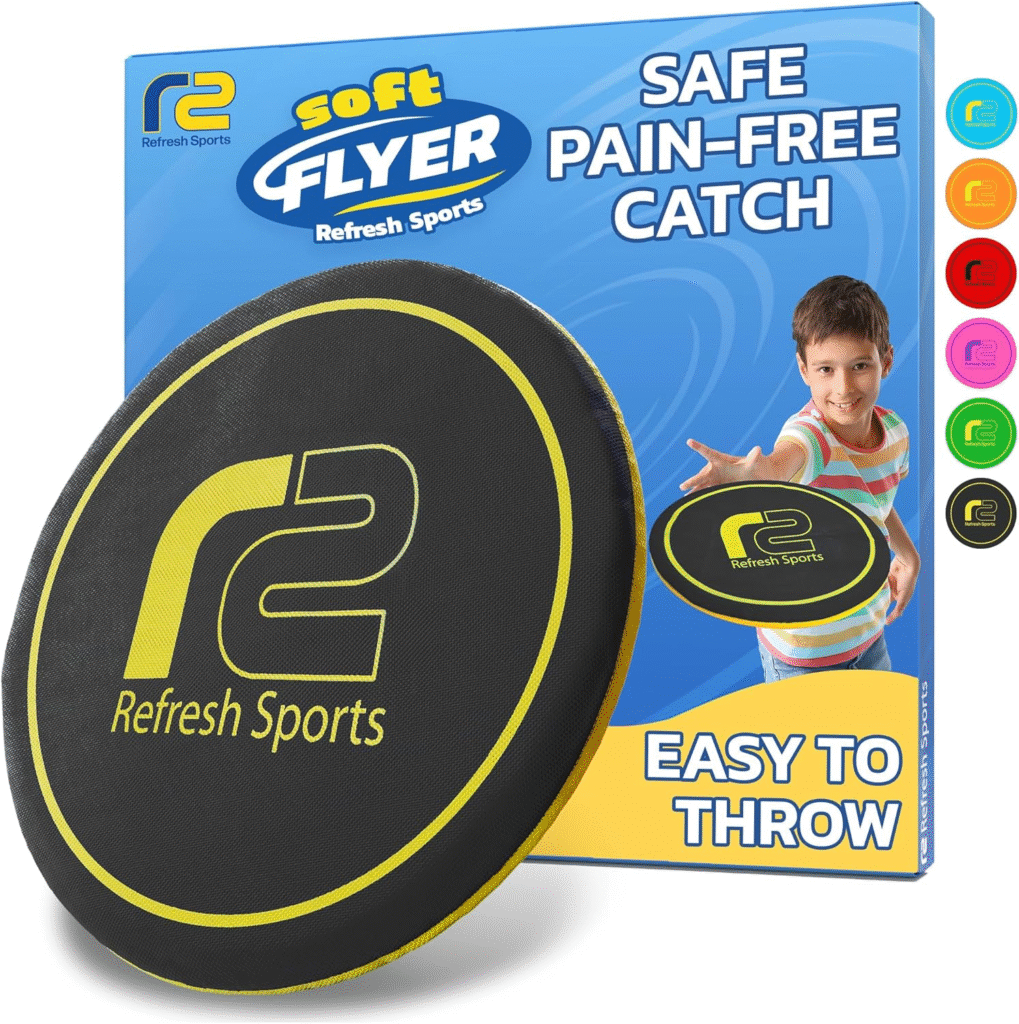
1. Refresh Sports Lightweight Soft Flying Disc
Best for: Rule-learning sessions where consistency and safety matter most
When students are focused on internalizing pivot rules, stall counts, and turnover logic for the first time, the last thing they need is a disc that behaves unpredictably or feels uncomfortable to handle. The Refresh Sports Lightweight Soft Flying Disc addresses both concerns with a design that prioritizes approachable handling and stable flight above everything else. Its soft outer construction removes any hesitation around aggressive catches, which means students stay focused on applying the rules correctly rather than shying away from contested disc situations.
The disc’s reliable flight path also makes it significantly easier to teach and reinforce boundary rules, since out-of-bounds calls are far cleaner when the disc travels on a consistent line. For PE teachers introducing a full ruleset across multiple weeks, this disc provides the kind of low-maintenance, session-after-session dependability that keeps lessons running without equipment-related interruptions.
✔️ Ideal for rule-focused sessions where disc behavior needs to be predictable
✔️ Consistent flight path supports clean boundary and turnover teaching
✔️ Soft exterior removes physical hesitation around contested catches
✔️ Dependable across extended multi-week use in outdoor settings
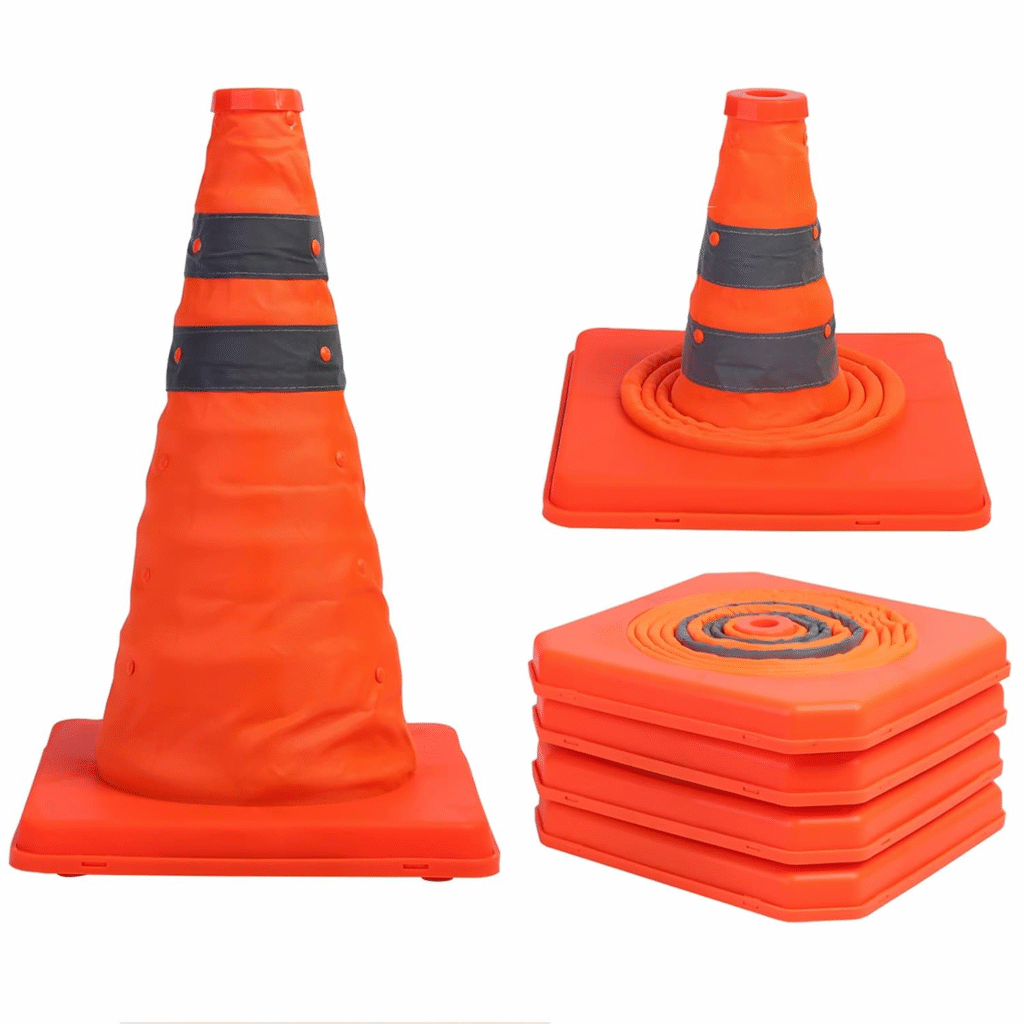
2. Sunnyglade 4 Pack 15.5-inch Collapsible Traffic Cones
Best for: Marking boundaries and end zones that make rule enforcement straightforward
Boundary disputes are one of the most disruptive sources of rule confusion in beginner ultimate frisbee, and vague field markings are almost always the root cause. The Sunnyglade Collapsible Traffic Cones eliminate that problem by giving you sharp, unmistakable visual anchors for every boundary line, end zone corner, and field division your session requires. When students can see exactly where the field begins and ends, out-of-bounds calls become obvious rather than debatable, which keeps gameplay moving and gives you more time for actual coaching.
Their collapsible, stackable design means you can reconfigure from a small-sided drill setup to a full-field game format in under two minutes without disrupting the rhythm of your lesson. Whether you are running four parallel mini courts for your rule introduction sessions or scaling up to a full field for late-unit play, these cones adapt to every configuration without any fuss.
✔️ Highly visible in both indoor gym and outdoor grass environments
✔️ Clear boundary definition reduces out-of-bounds disputes significantly
✔️ Fast reconfiguration supports smooth transitions between lesson formats
✔️ Stackable and portable for easy transport across multiple field setups
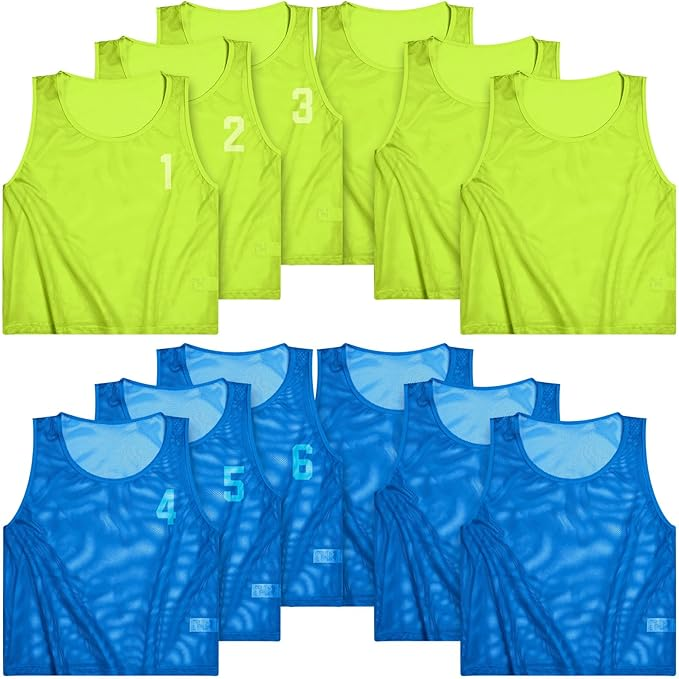
3. Boyiee Pinnies Scrimmage Vests
Best for: Organizing teams clearly during rule-application scrimmages
One of the quieter sources of chaos during early rule-learning scrimmages is simple team confusion — students throwing to the wrong person because team membership isn’t immediately obvious in the heat of play. The Boyiee Pinnies Scrimmage Vests solve this with bold, high-contrast colors that make team identity unmistakable from anywhere on the field. When students always know who is on their side, they can direct their mental energy toward applying the rules you’ve taught rather than sorting out basic game logistics mid-play.
These vests are also practical enough to handle the repeated on-and-off demands of a PE class, where students may change teams between rounds or rotate through modified game formats. The adjustable sizing and breathable construction keep comfort consistent across an entire class period, and the fabric retains its color vibrancy well enough that team distinction stays clear through a full semester of regular use.
✔️ Color vibrancy holds across a full semester of regular outdoor use
✔️ High-contrast colors eliminate mid-game team identification confusion
✔️ Easy on-and-off design suits frequent team rotations between rounds
✔️ Breathable construction maintains comfort through full class periods
Conclusion – The Bottom Line!
Ultimate frisbee rules don’t need to be complicated for school PE classes to run smoothly and safely. The streamlined version presented here captures the essential elements that make the sport fun and strategic without bogging down in technical details that confuse beginners.
Focus on core concepts like no running with the disc, avoiding contact, and scoring by catching in the end zone. Students grasp these basics quickly and can play meaningful games within just a few lessons. As your class gains experience, you can gradually introduce more nuanced frisbee rules that add strategic depth without overwhelming learners.
Want a complete plan that introduces all of these rules in the right order, at the right pace?
Get your free Middle School PE Unit Plan and bring structure and confidence to every session you teach. Here’s what you’ll find Inside.
1. A comprehensive Ultimate Frisbee curriculum designed specifically for middle school students.
2. Detailed lesson plans covering all core rules, throwing, catching, and game strategy.
3. Engaging drills and modified games that make rule learning stick.
4. Practical tips for managing self-officiation and sportsmanship in an inclusive PE environment.
